
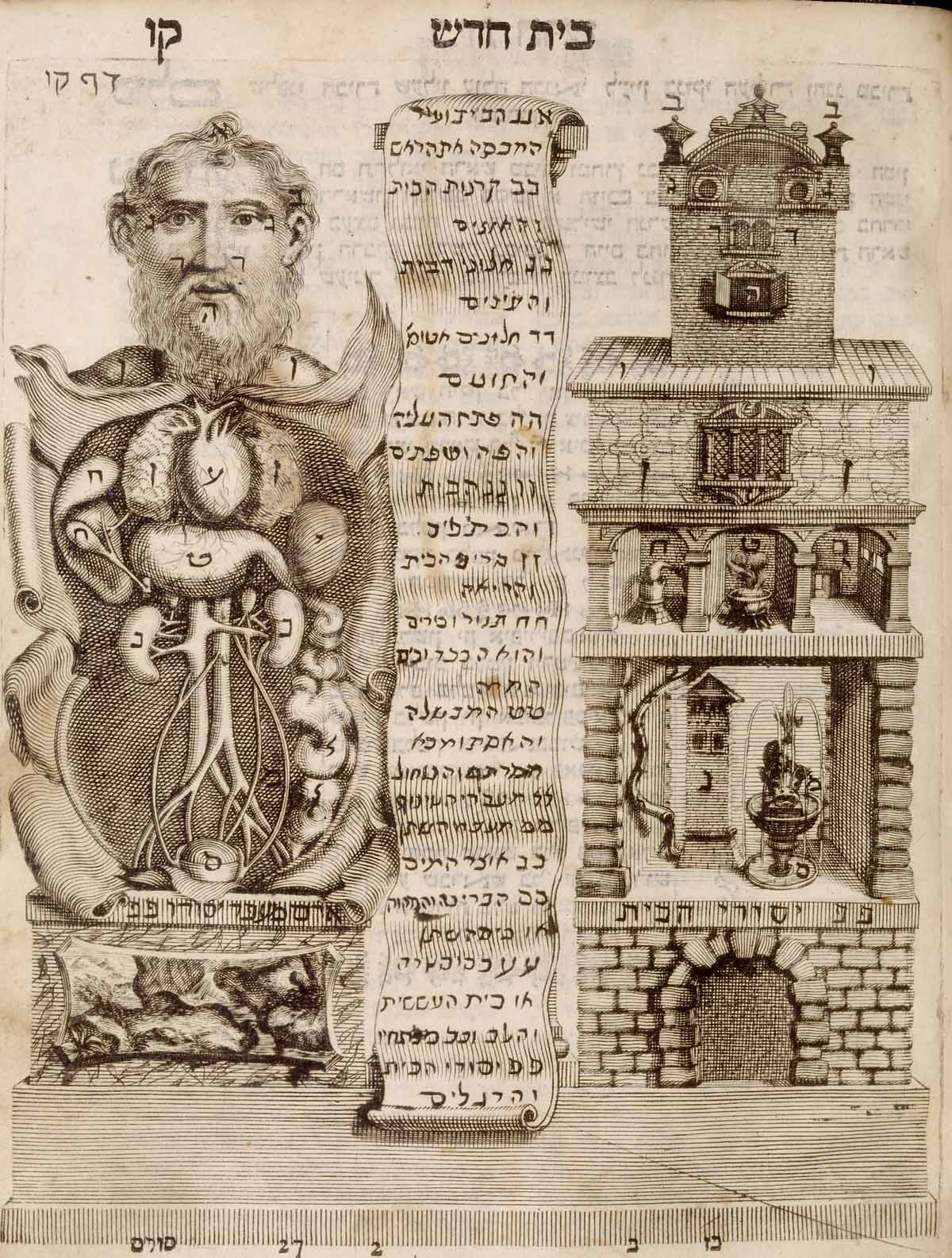
 Figure 1. Image Reconstruction of “Human Body as a House” based on “Human Body as a House,” woodcut. In: Tobias Cohen, Ma’aseh Tuviyah (Venice: Bragadini, 1707), p. 94. From the Dream Anatomy Gallery by the United States National Library of Medicine, https://www.nlm.nih.gov/exhibition/dreamanatomy/images/1200-dpi/I-A-2-07.jpg
Blood is power. Power can be achieved, through positions of authority, wealth, and fame. However, power can also come from our physical bodies, apparent through our skin color and sex characteristics. Delving deeper into ourselves, the formless and unapparent blood flowing within us can also be shaped into becoming a source of power.
How did that come to be?
The year is 1144, a young boy was found bloodied and dead in Norwich, England (1). The body, determined to be from a boy named William, was buried and left untouched until a monk by the name of Thomas of Monmouth decided to investigate (1). Thomas of Monmouth carefully crafted an account of William’s death, claiming that William was tricked into entering the home of a wealthy Jew and used as a part of ritual sacrifice (1). It was the blood, Thomas thought, that Jewish people were after, as he outlined the first case of what is now considered as “blood libel”—allegations against Jewish people that they used the blood of Christian children during religious practices like Passover (1).
Not long after, in 1215, these accusations were followed by discriminatory practices against Jewish people. The fourth Lateran Council, for example, forced Jewish people to wear a symbol to display their Jewish background (2). Blood libel spread, and led to depictions of Jewish people like those seen in the Simon of Trent woodcut—faces with a long and slanted nose, pointy beard, and bulging eyes (2).
This sets the stage for the anatomical illustration, “the human body as a house,” which appeared in 1708 in Tobias Cohen’s medical encyclopedia, Ma’aseh Tuviyah (Figure 1). Taken at face value, the illustration associated internal organs of a presumed Jewish man with parts of a house such as the intestines with the lavatory, kidneys with water reservoirs, and stomach with the kitchen (2). The illustration is bisected by a scroll that summarizes these associations in alphabetical order (3). Given this information, it is logical to believe that the illustration served as a mnemonic aid to help understand and memorize the role of different organs (3).
However, a deeper look into Cohen’s background reveals a more complicated story. Cohen, a Jewish physician-scholar, faced anti-Jewish sentiment firsthand, as his family had to flee persecution and he was forced to transfer from Frankfurt to complete his medical degree (4). His experiences played a critical role in the writing of his encyclopedia, as he was motivated to elevate the portrayal and perception of Jewish people (4).
How did Cohen manage to accomplish this?
Out of all the body parts that could have remained intact in the illustration, the face is the one that did. There is a reason why. The face has well-defined features, with a maintained beard, proportionate nose, and an assured gaze that stares right back into the readers (2). These details confront the negative portrayals the Christians imposed upon Jewish people, and depict that Jewish people were as human as their Christian counterparts (2). The knowledge written by Cohen about the body was thus entangled with his life experience, far from the impartial nature we associate with textbooks now.
Cohen also refutes the Christians the same way that the Christians subjugated Jewish people—blood. The illustration delineates the guts and the tissues blood travels through, and these same components are compared to the architecture of a home. This supports Cohen’s intentions in a two-fold manner. First, the candid display of the organs reinstates the humanness of Jewish people. Second, the body as a house embodies Cohen’s goal: to form a permanent home for his people in the Holy Land (2). Like many of his Jewish peers, Cohen was heavily impacted by the Jewish Diaspora, relocating multiple times in his life. By imparting form on the formless fluid, Cohen shaped blood to provide a message on his own terms—not the one set by Christians to justify the supposed inferiority of Jewish people.
Now, in the year 2021, medical knowledge has changed greatly from what was available in Cohen’s time, as the medicine we know has become associated with technological innovations. Blood and other fluids are now visualized through tools like MRIs and CT scans, siphoning power away from the patients as the physicians interpret these fluids through their own diagnostic processes. This imbalance in the physician-patient relationship is furthered by metaphors like medicine as war and illness as a battle. These factors combine to produce a framework in modern medicine that elicits paternalistic healthcare (5). Examination rooms and hospital beds become battle sites, as healthcare teams become fixated on the illness itself, losing focus of the patient right in front of them. Depersonalization occurs and has led to worse medical outcomes, especially in patients with cancer and individuals with rheumatoid arthritis (5).
Should similar power imbalances like what Cohen faced be perpetuated? Certainly, we do not want the voices of the patients to perish.
Works Cited
- Hartnell, Jack. Medieval Bodies: Life, Death and Art in the Middle Ages. Profile Books, 2018.
- Levy Morantz, Yael. “Metaphors of Body and Home: A Study of the Anatomical Illustration in ‘Ma’aseh Tuviyah.’” Thesis, The Graduate School, Stony Brook University: Stony Brook, New York, 2013. https://ir.stonybrook.edu/xmlui/handle/11401/76871.
- Lepicard, Etienne. “An Alternative to the Cosmic and Mechanic Metaphors for the Human Body? The House Illustration in Ma’aseh Tuviyah (1708).” Medical History 52, no. 1 (January 1, 2008): 93–105.
- Ruderman, David B. Jewish Thought and Scientific Discovery in Early Modern Europe. New Haven: Yale University Press, 1995.
- Bleakley, Alan. “Force and Presence in the World of Medicine.” Healthcare 5, no. 3 (September 13, 2017). https://doi.org/10.3390/healthcare5030058.
Sound Effects/Music Credits
- Fesliyan Studios for Suspenseful Background Music
- Free High Quality Sound FX for Paper Rustling Sounds
- Free Sounds Library for EKG Sounds
- Sound Jay for Water and Fire Sounds